The Best Time of Day to Walk and Exercise
March 21, 2012
Wendy Baumgardner, About.com’s “walking guide,” tackles the topic in a piece called “The Best Time of Day to Walk and Exercise.”
The Best Time of Day to Walk and Exercise
By Wendy Bumgardner, About.com Guide – Updated March 15, 2012
About.com Health’s Disease and Condition content is reviewed by our Medical Review Board
Is there a best time of day to walk?
Research on lung function, body rhythms, temperature, and hormone levels says one thing — to exercise around 6 p.m. Read more
Exercise has numerous beneficial effects on brain health and cognition, review suggests
March 19, 2012

How can you maximize your brain activity and put a stop to the growing obesity statistics? Urban Poling gives you an aerobic workout and resistance training all done at the same time – think cross-country skiing year round.
Exercise has numerous beneficial effects on brain health and cognition, review suggests
Winter Walking Clinic
February 20, 2012
Winter is a great time of year to get outside and enjoy the snow and fresh air, but to fully enjoy your outdoor winter walking experience, you need to be prepared.
In this 3-part video clinic, Occupational Therapist and Co-Founder of Urban Poling shares her best tips on how to safely enjoy your nordic walking poles during the winter months.
With this info, you’ll have everything you need to stay fit and healthy this winter!
The 10 essentials – For casual winter walking or more advanced winter hiking or snowshoeing.
PART 1
Step 1 – The Basics
Step 2 – Snow and Trekking Baskets
Step 3 – Adjusting the pole length
Physiotherapists give thumbs…
October 21, 2011
Canada NewsWire
OTTAWA, Oct. 19, 2011
An increasing number of Canadian physiotherapists are realizing the benefits of Nordic pole walking for their patients, adding a rehabilitation dimension to the already-popular fitness trend.
Nordic pole walking boasts an easy-to-learn technique, with little risk to the body. It helps strengthen core muscles, contributes to weight loss and decreases stress on hips and knees. The versatility of the activity makes it appealing to physiotherapists, who see it as ideal for people with mobility issues, or those living with chronic conditions such as arthritis.
While Nordic walking can be practised almost anywhere, it’s important to have the right equipment and instruction. “Don’t be tempted to use skiing, hiking or trekking poles, which are designed for totally different purposes,” says Cathy McNorgan, a physiotherapist and certified Nordic walking instructor. All Nordic poles have a spike tip at the bottom for walking on variable outdoor terrain, covered by a rubber tip that grips sidewalks and other surfaces, to ensure safe use. Read more
We’re in Zoomer!
October 8, 2011
- By Athena McKenzie
POLE APPEAL
I may be walking with poles as I stride through the trees, but group leader Barb Gormley is quick to point out that unless I’m using the proper technique, I may as well be walking with sticks. Gormley, the director of education for Urban Poling – a company that promotes what is also known as Nordic walking and sells the poles – is guiding a group of us through the trails of Toronto’s High Park. The regular members of this particular group, ranging in age from 20 to 70, meet every Sunday. Newcomers are shown the basics using lightweight poles, which have an ergonomic strapless handle and boot-like tips.
The incentives to use the right technique are compelling. As opposed to walking, which only engages the muscles under your belly button, urban poling uses 90 per cent of the muscles in your body by bringing the upper body into the workout.
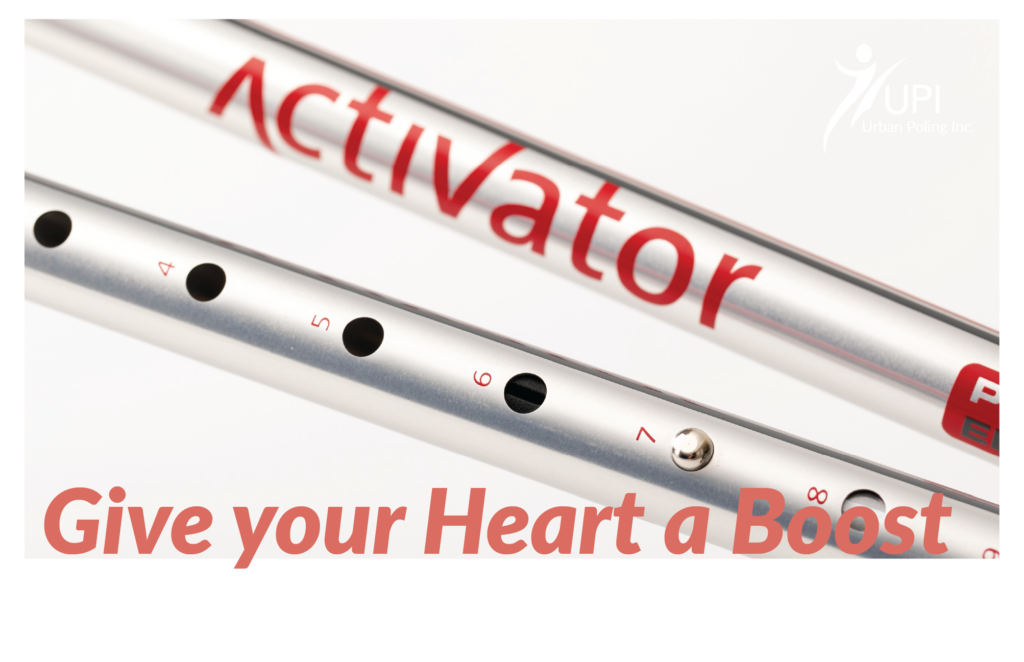
One of the draws to urban poling is how accessible it is to all age groups, especially seniors. There are specially designed Activator poles targeted at seniors and those recovering from chronic conditions and injuries. The strapless ergonomic handles are ideal for those with arthritis, and the bell-shaped tips provide greater stability and weight-bearing capabilities than the regular urban poling’s boot-shape tip.
Graham Watts, a co-founder of Urban Poling Inc., says Activator poles are also a useful aide in preventing falls. “For a lot of seniors, confidence becomes an issue, and now you have two poles in your hands, so you have this added support,” he says.
Using the poles reduces the impact on the knees, hips and ankles. Also, users show improved posture and improved bilateral and rhythmic movement.
But don’t think only people with restraints on their mobility can get a workout from urban poling. One proponent of this fitness activity is Lynn Kanuka, who is best known for her bronze medal performance at the Los Angeles Olympic Games in 1984.
Even as a high-performance athlete, Kanuka finds that walking with urban poles provides a baseline for fitness and gets her outside.
“I think I’m stronger in my running at this stage of my life because of my Nordic walking,” she says. “I’ve never enjoyed my own walking or running more.”
“It’s literally an elliptical trainer on wheels and it’s a fantastic way to move without any impact,” she says. “It gets you out of the gym and onto the streets and trails in the fresh air.”
Getting outside is part of the appeal of Nordic walking and the trend is spreading across the country. According to Watts, community centres are offering classes, many seniors homes incorporate it into therapy, and even high schools have sessions.
Kanuka imagines a time in the near future where Nordic walking is as popular in Canada as it is in Scandinavia, where it originates. She describes how most trails there are designated for pole walkers. On this Sunday when I am walking in High Park, however, the poles are in the minority and attract quite a few looks – and the odd shout-out of “Hey, you forgot your skis.” Something that makes the regulars groan.
But they’ll have the last laugh. Because they know that this is so much more than walking with sticks.
Fast Facts -
Walking one mile with poles engages 1,800 contractions of stomach muscles and 900 of back muscles.
Seniors who regularly walk with the Activator poles say they have less neck, shoulder and back pain.
Nordic walking increases calorie burning by up to 46 per cent compared to walking alone.
Other recent news events:
- The Best Time of Day to Walk and Exercise
- Exercise has numerous beneficial effects on brain health and cognition, review suggests
- Sarah Merkel Wins Urban Poling 2012 Trailblazer Award
- Winter Walking Clinic
- Nordic Walkers To Make Big Impact – Vancouver Sun Run 2012
Canadian Living Magazine – Urban Poling
September 17, 2011

Nordic-Walk Your Way to Weight Loss ~by Cheryl Embrett
We thought you’d be interested in this feature article, “Nordic-Walk Your Way to Weight Loss,” just published in Canadian Living magazine. It’s an inspiring first-person story from an Urban Poling class participant and former marathon runner who has fallen in love with poling.
“After four months of walking three or four times a week in all kinds of weather, I’ve lost 10 pounds, my arms are more toned, and I feel re-energized,” says the author Cheryl Embrett.
Download your own copy- Click Here
Review a full list of articles in our “media centre.”
Other recent news events:
- The Best Time of Day to Walk and Exercise
- Exercise has numerous beneficial effects on brain health and cognition, review suggests
- Sarah Merkel Wins Urban Poling 2012 Trailblazer Award
- Winter Walking Clinic
- Nordic Walkers To Make Big Impact – Vancouver Sun Run 2012
Physiotherapy Practice
August 25, 2011
Canadian Physiotherapy Publication 2011
Physiotherapy Practice – Features Activator & Urban Poles
Download your own copy- Click Here
Three ways physiotherapists are using Nordic walking poles in their practice
Canadian physiotherapists have begun to integrate![]()
Nordic walking techniques into their practice. It offers many significant potential benefits and can be introduced to a variety of patients at various stages of rehabilitation. For example, Nordic walking poles may help achieve treatment
goals with:
Patients who want to improve their general health and fitness. Compared to standard walking, Nordic walking burns more calories, improves posture, and strengthens the core and upper extremities. This makes it an excellent activity for people who need to lose weight and generally be more active. These individuals generally exercise independently with friends or an organized Nordic walking group.
Patients with chronic conditions. Pole walking provides a larger base of support for individuals
who have deficits in their balance or coordination skills. The “four-on-the-floor” approach to walking may benefit individuals with chronic conditions who may be able to exercise independently or with minimal assistance. People with early stage Parkinson’s disease or multiple sclerosis or those who have experienced a brain injury may be considered, and could be introduced to the exercise indoors one-on-one with a physiotherapist. The fluid, rhythmical motor pattern can assist in improving coordination and restoring patterns of movement.
Patients who are post-surgery and/or are in pain. Nordic walking poles were introduced to physiotherapy clients at Vancouver general Hospital’s Acute Spine Program in the fall of 2010. using these poles offloads weight from the hips, knees and lower spine, and into the upper body, making it ideal for some clients who have arthritis or low back pain, or are easing back into activity after surgery.
Physiotherapist Hilary Jebson works with patients recovering from spinal surgery…
Download your own copy- Click Here
Fight Diabetes with U.P.
January 19, 2011
As a busy mother of three, Lee-Anne Kennedy finds it challenging to fit workouts into her busy schedule. But as a person with diabetes, she knows that exercise has to be a priority in her life. She’s an avid skier, walker and former runner, but her current favourite workout is urban poling, also known as Nordic walking.
“It’s so simple to just grab my walking poles and head out the door for a workout,” says Kennedy, who is also a nurse and diabetes educator. “Urban poling really helps me keep my blood sugar in a healthy range, and it helps control my weight too.”
Using the walking poles properly is the key to getting the benefits, says Kennedy, who lives in Deep River, Ontario. Most people need only one or two lessons to develop good form.
When Margaret Helmuth needs help managing her diabetes, she counts on urban poling, too. She tried brisk walking, but it didn’t elevate her heart rate to the level her doctor recommended, and it had only a minor effect on her blood sugar levels.
Then, about two years ago, she found that urban poling offered just what the doctor ordered.
“Walking with poles never fails to bring down my sugar levels,” says Helmuth, who lives in Toronto. “And I always reach my target heart rate when I walk with my poles.”
For more information on Urban Poling, or to find an instructor in your area, visit the Urban Poling website.
Story submitted by Barb Gormley, Urban Poling Inc. Published in the January 2011 PartcipACTION Newsletter.
Urban Poling Scholarship (UBC)
December 8, 2010
Press Release – For Immediate Release
December 08, 2010
Urban Poling Activator Scholarship Announced!
Congratulations To: Sarah Neil, Rehabilitation Sciences at the University of British Columbia

Urban Poling Inc. is proud to announced that we have partnered with University of British Columbia (UBC) and the Faculty of Medicine to create an Urban Poling Activator Award in Rehabilitation Sciences. This scholarship will support Masters and Ph.D. students to carry out unique programs in rehabilitation and cancer research.
Our first scholarship was presented to Sarah Neil, a student in the department of Rehabilitation Sciences at the University of British Columbia.
Sarah received a Bachelor’s degree in Kinesiology with a minor in Rehabilitation Sciences from the University of Western Ontario in 2009. She is now working towards a Master of Science degree, supervised by Dr. Kristin Campbell. Her research interests are focused on the role of exercise throughout the cancer continuum of prevention, treatment and survivorship.
Her thesis project is an observational study examining physiological differences between breast cancer survivors who are experiencing chronic fatigue after treatment, and breast cancer survivors who do not experience fatigue. The aim of the study is to determine which factors may contribute to this chronic fatigue, in order to design an exercise intervention that is specifically tailored to target fatigue. She hopes to complete her MSc degree this summer in order to begin her PhD in September 2011.
Co-founder Mandy Shintani says, “Urban Poling is absolutely committed to creating and promoting fitness education in our communities. Our goal is get people active and make rehabilitation easier and more effective.”
Urban Poling’s support and funding for this scholarship is a small part of our larger strategy to give back to our communities in ways that matter the most. For more information on our other initiatives, check out the Community Outreach portion of our website.
ABOUT URBAN POLING INC.
Urban Poling Inc. is a Canadian company based in Vancouver. The co-owners are Mandy Shintani and Graham Watts. Mandy Shintani, an occupational therapist is considered one of the leading experts on the health and fitness benefits of Nordic walking in Canada. Urban Poling Inc. is manufacturer of the Urban Poling poles and also operates one of Canada’s largest certification centres. Urban Poling runs the only Nordic walking training centre in Canada that is recognized by these six fitness education organizations including:
- Can Fit Pro
- British Columbia Parks and Recreation
- Ontario Kinesiology Association
- Manitoba Fitness Council
- Saskatchewan Parks and Recreation Association
- Alberta Fitness Leadership Certification Association
Graham Watts & Mandy Shintani
Co- Founder and Directors
Urban Poling Inc.
Tel. (604) 990.7711
www.urbanpoling.com
mandy@urbanpoling.com
Nordic Walking Pilot Trial – McGill University
October 29, 2010
Canadian Physiotherapy Association, May 2010.
A003 –Nordic walking for geriatric rehabilitation: A randomized pilot trial
1)Faculty of Medicine, School of Physical and Occupational Therapy, McGill University, Montreal, Qc, Canada2)Division of Clinical Epidemiology, McGill University, Montreal, Qc, Canada3)Faculty of Medicine, Department of Geriatrics, McGill University, Montreal, Qc, Canada


Introducing the Limited Edition 4LIFE Nordic walking poles!